

1,314 Hospitality Professionals. 12 Countries. 4 Weeks. One Question: Is Your Hotel Ready for AI?
Inside One of the Largest AI Education Initiatives in Hospitality
In April 2026, we set out to answer a simple question: what happens when you stop talking about AI in hospitality and start showing it?
The answer came faster than we expected. Within 72 hours of announcing our AI in Hospitality Certificate Program, the first session hit capacity at 1,000 registrations. We opened a waiting list. It filled too. By the time the four-week program concluded, 1,314 professionals from 12 countries had participated — and 726 had earned their certificates.
But the numbers, as impressive as they are, aren't the real story. The real story is who showed up, and what that tells us about where this industry is headed.
The Room Was the Message
Look at who registered, and you'll see an industry in transition.
88 General Managers cleared their Wednesday afternoons to learn about AI. Not their IT teams. Not their junior staff. The people who run hotels.
254 department heads and senior managers joined alongside
141 sales and marketing professionals — the people directly responsible for revenue and guest experience.
86 front office professionals — the very people whose daily reality we were reimagining — came to see what AI means for their roles.
82 academics and researchers participated, many of them actively studying the future of hospitality operations.
222 hospitality students represented the next generation — future GMs who will grow up with AI as a native tool, not a novelty.
And
51 entrepreneurs and founders showed up looking for what's next.
They came from
436 different hotel properties — from global chains to independent boutiques. Hilton. Hyatt. Rixos. Wyndham. Radisson. Marriott. Accor. Limak. Dedeman. Swissôtel. Ramada. Holiday Inn. And hundreds of independent properties whose names you might not know but whose operations face the exact same challenges.
They came from
151 different universities — Ankara Hacı Bayram Veli, Akdeniz, Muğla Sıtkı Koçman, Pamukkale, Özyeğin, İstanbul, and dozens more.
They came from 12 countries across six regions — from the Americas to Asia, Africa to the Caucasus, Europe to the Middle East.
This wasn't a webinar audience passively consuming content. This was an industry mobilizing.
The Contrast Principle
We designed every session around a concept we call the
Contrast Principle.
The idea is simple: before you can appreciate what AI does, you need to feel what life is like without it.
So each week, a distinguished hospitality professor opened the session by painting a brutally honest picture of current hotel operations. Not the brochure version — the real one. The one where a receptionist answers "What time is breakfast?" for the 200th time while three phone lines ring simultaneously and a guest who doesn't speak the local language stands at the counter looking lost.
Then we took over. Same scenarios. Same questions. Same operational chaos. But this time, handled by an AI receptionist — live, in real time, with the audience watching.
No slides. No mockups. No "imagine if." Just a working AI system doing what we claimed it could do.
The silence in the chat after the first live demo told us everything. Then the questions exploded.
What We Actually Showed
Every demonstration ran on RecepAI — our AI receptionist platform purpose-built for hotels. This wasn't a generic chatbot demo. This was a production system serving real hotels, used as a live teaching tool.
Week 1 — Building an AI Receptionist from Scratch
Prof. Dr. Ece Konaklıoğlu opened with the daily reality of a hotel front desk — the relentless pace, the repetitive questions, the language barriers, the impossible multitasking.
Then we built an AI receptionist live, in front of 1,000 people. Prompt engineering to define personality and behavior. Document training to teach it everything about a hotel. Skill configuration for operational tasks. Deployment to web, WhatsApp, Telegram, and voice channels. The entire process — from zero to a functioning AI receptionist answering guest questions — took under an hour.
Week 2 — The Digital Front Desk
Prof. Dr. Gürel Çetin explored traditional front office operations — the fragmented systems, the lost preferences, the communication gaps between shifts.
We demonstrated real-time guest profiling, intelligent service request management, and a unified digital front desk that ensures nothing falls through the cracks. A guest's preference for extra pillows, noted in a chat message at 11 PM, automatically appears in the morning briefing.
Week 3 — The Most Expensive Silence
Prof. Dr. Burçin Cevdet Çetinsöz quantified what most hotels ignore: the cost of unanswered reviews. Every review left without a response is a future guest who forms their opinion in silence.
We showed AI-powered review intelligence — real-time sentiment analysis, automated personalized responses, pattern detection across thousands of reviews, and operational insights that turn guest feedback into measurable improvements.
Week 4 — AI as Your Revenue Partner
Assoc. Prof. Dr. Kader Şanlıöz Özgen examined traditional upselling — the awkward pitches, the generic offers, the missed moments.
We demonstrated AI-driven personalized selling: the right offer, to the right guest, at the right time, through the right channel. Not a popup. A conversation.
The Academic Partnership That Made It Work
This program could have been a product demo series. We deliberately chose a different path.
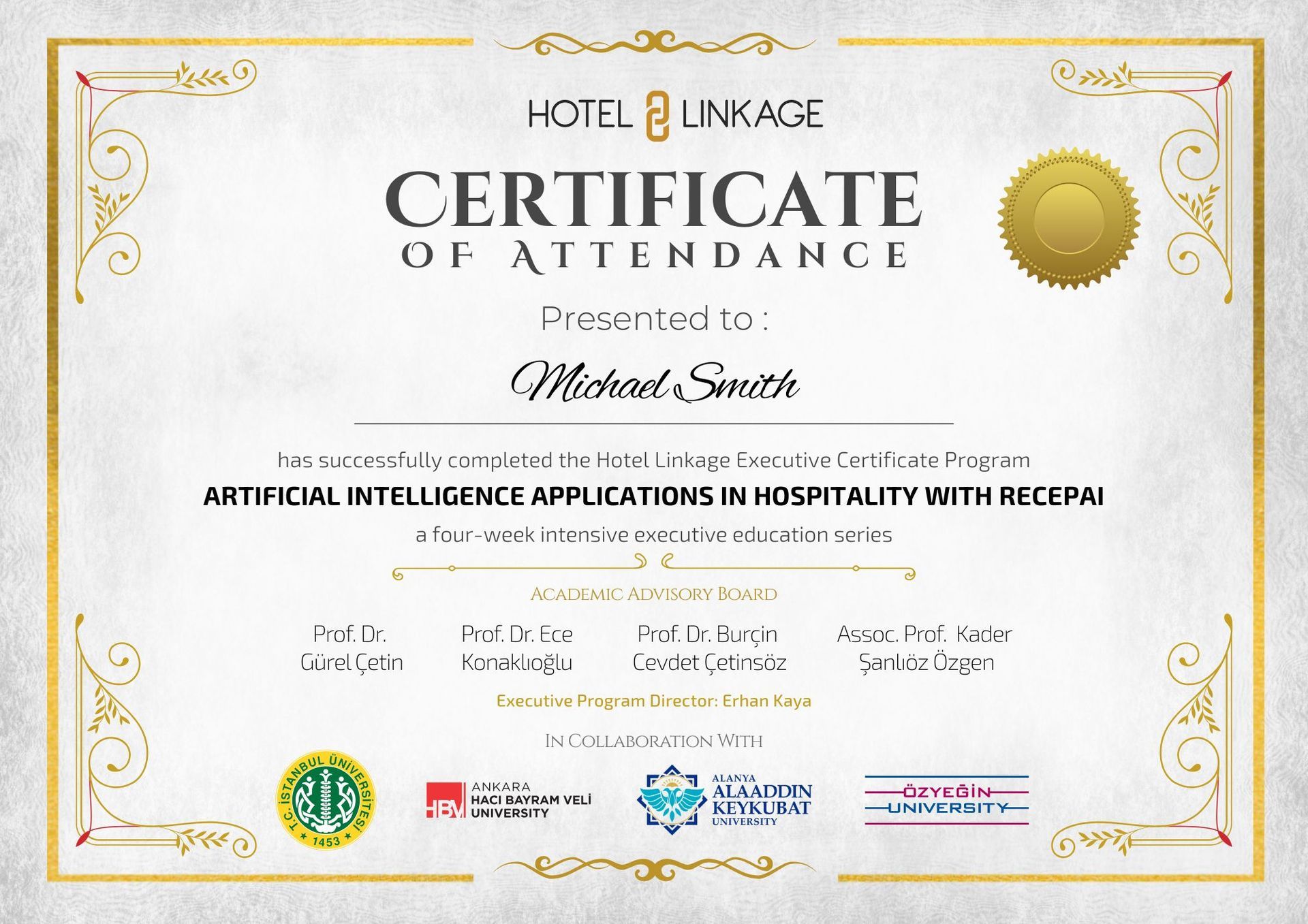
Four universities joined as institutional partners — İstanbul University, Ankara Hacı Bayram Veli University, Alanya Alaaddin Keykubat University, and Özyeğin University. Their logos appeared on every certificate, and their participation signaled something important: this wasn't a sales pitch. This was education.
The Academic Advisory Board — Prof. Dr. Gürel Çetin, Prof. Dr. Ece Konaklıoğlu, Prof. Dr. Burçin Cevdet Çetinsöz, and Assoc. Prof. Dr. Kader Şanlıöz Özgen — brought decades of hospitality scholarship that grounded every session in operational truth.
We rehearsed with each professor before their week. Not to script them, but to calibrate the handoff — where their reality ends and the AI demonstration begins. That transition point, that moment of contrast, was where the learning happened.
726 Certificates, and What They Represent
In May, we delivered 726 certificates to participants who completed the program.
But a certificate is just a PDF. What actually happened over those four weeks was something harder to quantify: a shift in perception.
The most common question in Week 1 was: "Can AI really handle the complexity of hotel guest interactions?"
By Week 4, the question had changed to: "How quickly can we implement this?"
That shift — from skepticism to urgency — is the real outcome of this program. It doesn't fit on a certificate, but it's worth more than one.
What This Tells Us About the Industry
When 88 General Managers voluntarily attend a four-week AI training program, it's not curiosity. It's a signal.
The hospitality industry has watched from the sidelines as AI transformed customer service in banking, retail, airlines, and healthcare. Hotels — an industry built entirely on guest experience — have been surprisingly slow to move.
That's changing. And the speed of that change caught even us off guard.
We expected maybe 300 registrations for the full program. We got 1,314. We expected polite interest. We got GMs asking for implementation timelines before the first session ended.
The demand isn't for more AI content. There are thousands of webinars and articles about AI in hospitality. The demand is for proof. Show me it works. Show me how to build it. Show me what it costs. Show me what happens when a guest asks something unexpected.
That's what we provided. And judging by the response, the industry was starving for it.
What's Next
We're bringing this program to the United States. A hands-on AI Hospitality Masterclass in South Florida, where hotel executives won't just watch a demo — they'll build and deploy their own AI receptionist during the session.
We're also in conversations with American universities about integrating this curriculum into hospitality management programs. Because the students graduating today will manage hotels where AI is as fundamental as a property management system. They need to be ready.
The hospitality industry doesn't need more AI evangelism. It needs practitioners who can bridge the gap between what the technology can do and what hotels actually need.
That's the work. And it's just getting started.
Erhan Kaya is the CEO of Hotel Linkage and the creator of RecepAI. Hotel Linkage serves hundreds of hotels across the world, helping them increase direct revenue and distribute their rates across hundreds of OTAs.
Hotel Linkage is a leading name within the hospitality industry to offer hoteliers a complete solution in increasing their direct bookings whilst maintaining a focus on providing a revenue maximizing web-design with cutting edge CMS, booking engine and channel manager software.
Explore Our Suite of Digital Solutions
Our interactive product showcase below offers a streamlined overview of the diverse tools we provide. Simply hover over the '+' icons to reveal a succinct description of each offering. For a hands-on experience with our cutting-edge technology, we invite you to take advantage of our complimentary demo. Click on 'Try a Free Demo Today' for an in-depth exploration tailored to your needs.
